Adhering to the Teaching Quality Standard
Artefact ONE: Farewells From my Students
TQS-1: Fostering Effective Relationships
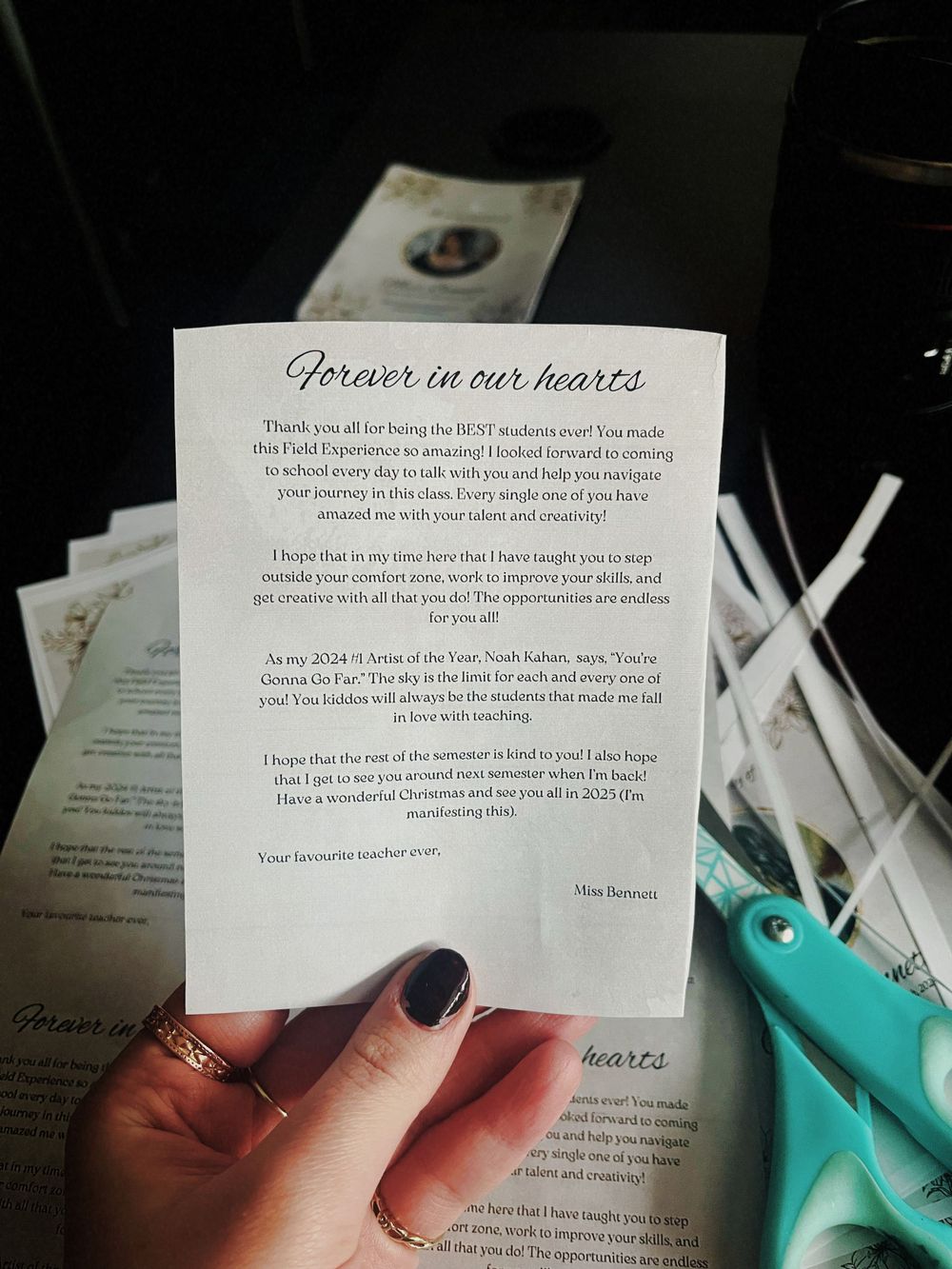
As an individual, I genuinely enjoy getting to know people, and as a teacher, I love building relationships with my students. During my Field Experience III, I aimed to create an environment where my students felt comfortable approaching me with anything—whether it was questions about the class and the concepts we were learning or concerns about how they were being treated at school. My goal was to be a positive role model and a supportive ally they could rely on. I believe I succeeded in this, as my students were visibly upset when they learned my time in their classroom was coming to an end.
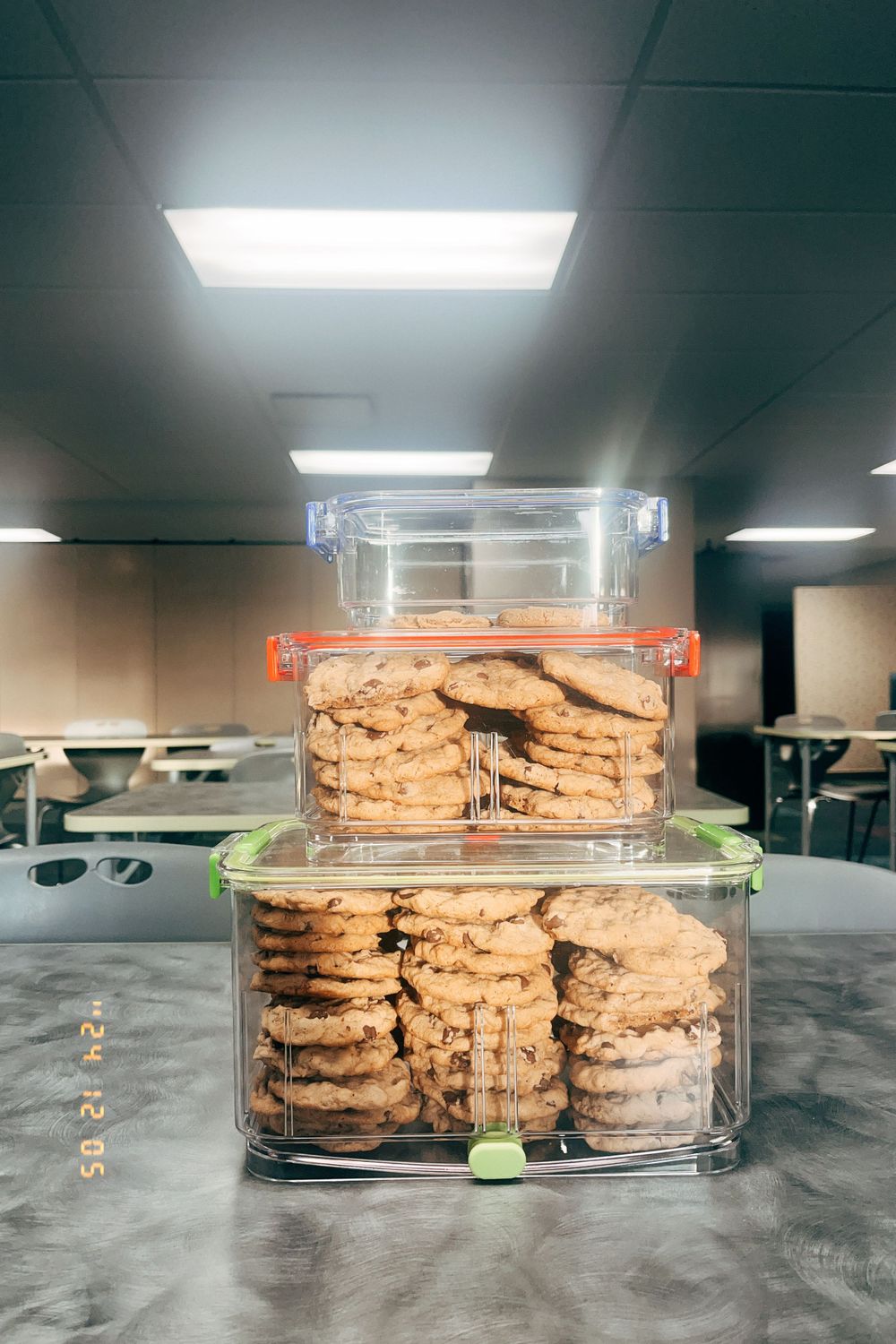
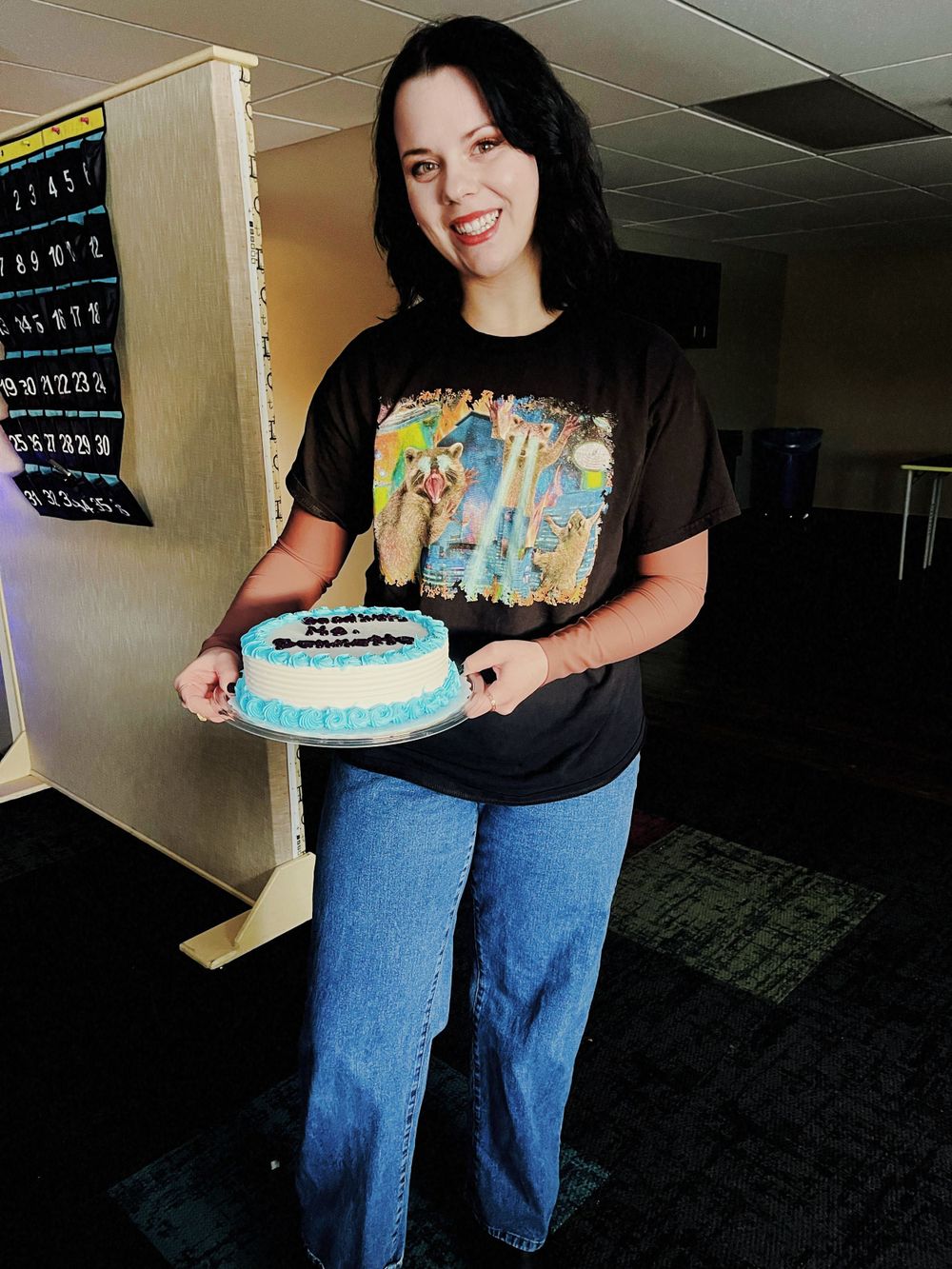
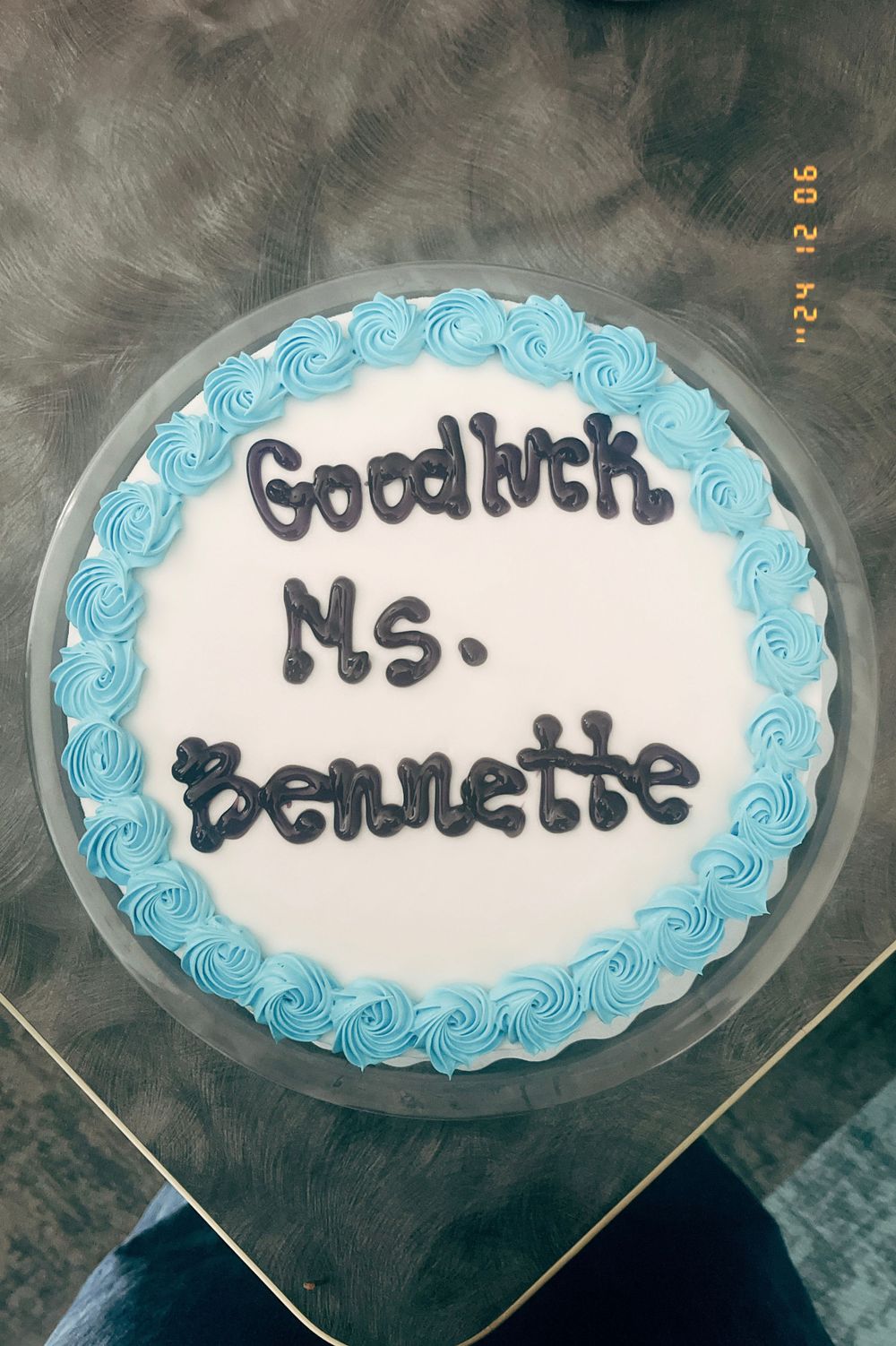
To bid farewell, I organized a potluck with my Period 1/2 advisory class and baked homemade oatmeal chocolate chip cookies for them. Having a severe food allergy myself, I was mindful of any dietary restrictions my students might have (e.g., gluten-free or dairy-free) and brought alternative cookies to ensure everyone could participate. During the potluck, my students surprised me with an ice cream cake and wished me luck with the rest of my post-secondary education.
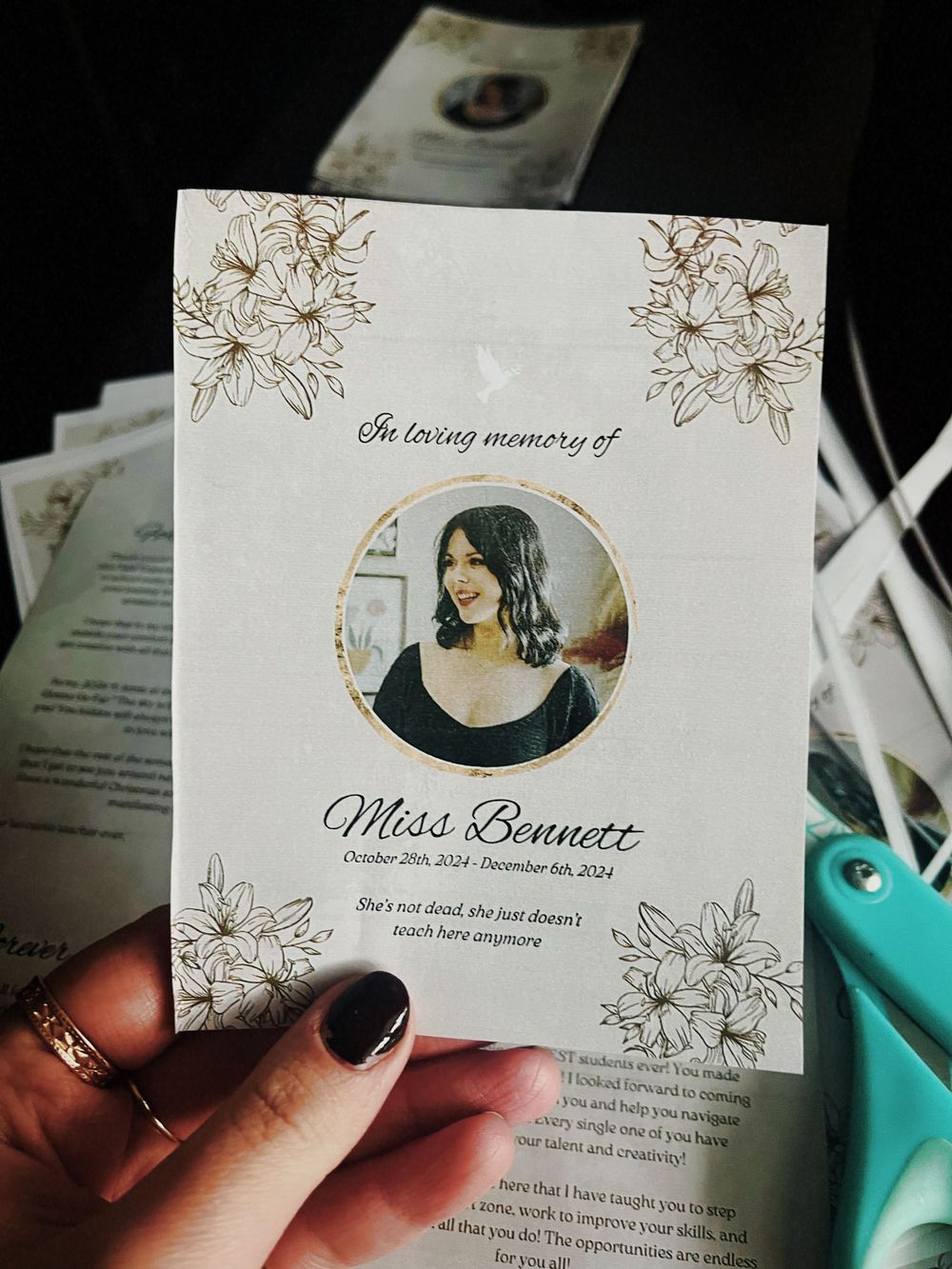
On my last day, I became emotional, knowing I wouldn't see these students I'd spent five weeks with every day. As a parting gesture, I created "obituaries" for myself that read: "In loving memory of Miss Bennett. She's not dead, she just doesn't teach here anymore." My students found them quite funny and appreciated the heartfelt message I wrote on the back. Before the day ended, they gave me handmade cards, shared warm hugs, and made my farewell truly special. It was such a sweet and memorable moment!
Artefact Two: FIELD EXPERIENCE III JOURNAL
TQS-2: Engaging in Career-Long Learning
Lifelong learning has been a significant focus throughout my post-secondary education. For both personal reasons and to meet the requirements of my Field Experience III, I maintained a journal throughout my five-week practicum placement. This journal included weekly reflections and notes after every lesson I facilitated. In each reflection, I highlighted what went well and identified areas for improvement, striving to enhance my lessons with each time I taught it
.
These entries were guided by my own thoughts on the lessons and the feedback I received from my students. I would argue that I learned more from my students during Field Experience III than they learned from me. They introduced me to new techniques for editing photos and videos that I hadn’t encountered before and offered fresh perspectives and ideas on the subject matter.
Through these reflections, I made adjustments to my lesson plans to ensure a smoother learning experience for my students. I believe that I will continue taking notes and revising these plans throughout my career, as each group of students brings unique dynamics and needs to the classroom.
ARTEFACT THREE: FIELD EXPERIENCE III WEEK 5 LESSON PLANS
TQS-3: Demonstrating a Professional Body of Knowledge
One phrase I learned at a young age is, "When you fail to plan, you plan to fail," and I wholeheartedly believe it is true! Being prepared while teaching not only makes my lessons more organized but also helps me stay on track. In my lesson plans, I make it a point to outline the curriculum requirements and objectives, providing a solid foundation for structuring my lessons.
Listing these objectives and setting clear learning targets ensures I avoid duplicating content and stay mindful of the class' timeline. By planning ahead, I can design cohesive units and assessments, minimizing confusion for my students. Well-structured lesson plans also enable me to give students a preview of what to expect in the upcoming week or provide additional assignments for those who progress faster than the rest of the class.
Ultimately, thoughtful planning allows me to create an efficient and adaptable learning environment that benefits all my students.
Artefact FOUR: INTRO TO MANUAL MODE SLIDESHOW
TQS-4: Establishing Inclusive Learning Environments
This presentation was a part of a lesson plan that I made for my Field Experience III in the Photography 10 class I was teaching. I have always been someone who learns in non-traditional ways, so this category of the TQS has always struck a personal chord with me. Because of my past experiences, and being a visual and hands-on learner, I have always tried to prioritize the incorporation of various learning and teaching styles within my lessons.
In this particular artefact, students will notice various explainantions and visual demonstrations within the slideshow. As a form of visual art, photography can be very difficult to explain solely with a series of sentences, as the essence of photography is to tell a story without uttering a single word. Furthermore, the theory behind photography is just half of the art, the other half is the experience. Below is a breakdown of what learning styles I incorporated to help establish an inclusive learning environent in the classroom and my thought process behind it!
Traditional lecture notes: Although my pedagoical approach tends to stray away from traditional teaching styles, I do understand that many students are used to standard lecture notes that they are able to refer back to. In this lesson I made sure to write down key phrases, words, and concepts in the slideshow while giving the class their lecture.
Diagrams: When covering concepts such as aperture, shutter speed, and ISO, it can be difficult for some students to visualize what I am discussing with them or can overcomplicate it. To overcome this hurdle, I included simple diagrams to show the effects of changing the camera’s manual mode settings and how it affects the overall image.
Exemplar Photos: Many people know the different looks in photography but do not understand the process behind achieving them. After disussing various settings and how they change the image, I ensured to showcase an example photo of how the settings are represented in a finished image. This allows students to understand how different looks in photography may be achieved while giving them inspiration for their own photoshoot assignments. All photos in this presentation are my own, allowing me, as the teacher, to have the ability of explaining to them the exact process of taking and editing the photo.
Videos: Although I am confident in my knowledge on the subject of photography, I always believe that it is beneficial to learn something from various perspectives. There is a possibility that a student in my class may better understand how someone other than myself explains key concepts. For that reason, I incorporated a video of someone briefly going over manual mode settings and how to adjust them. Here is a link to the video I incorporated segments of within the presentation https://youtu.be/elLk7CPYOj0?si=4HF1Kosl9pFhUWrz.
Hands-On Activities: Photography is considered a trade, and like any trade requires hands-on experience in order to improve students' skills. I like to incorporate hands-on activities within my lessons as pieces of formative assessment, not only as a way to allow students to apply theory to the reality of the craft, but also to have the ability of helping students one-on-one or in small groups as they go. Very often in this class I have noticed that students don’t have questions until they are actually taking the photos, so I thought that this would be a beneficial practice for all students’ learning. I like to compare the incorporation of hands-on activities to learning a card game. When someone explains the rules of a card game to you, oftentimes it is confusing and hard to grasp until you get to be a part of a couple of practice rounds. Activity below...
Take one photo…
- Outside
- Inside
- Of someone in motion (CANNOT BE BLURRY)
- Of an object with a shallow depth of field
- Of a creative photo of your choosing
Once completed, please submit your photos onto Google Classroom. We will go over and critique them as a class.
ARTEFACT FIVE: INTRO TO LIGHTROOM ACTIVITY
TQS-5: Applying Foundational Knowledge about First Nations, Métis and Inuit
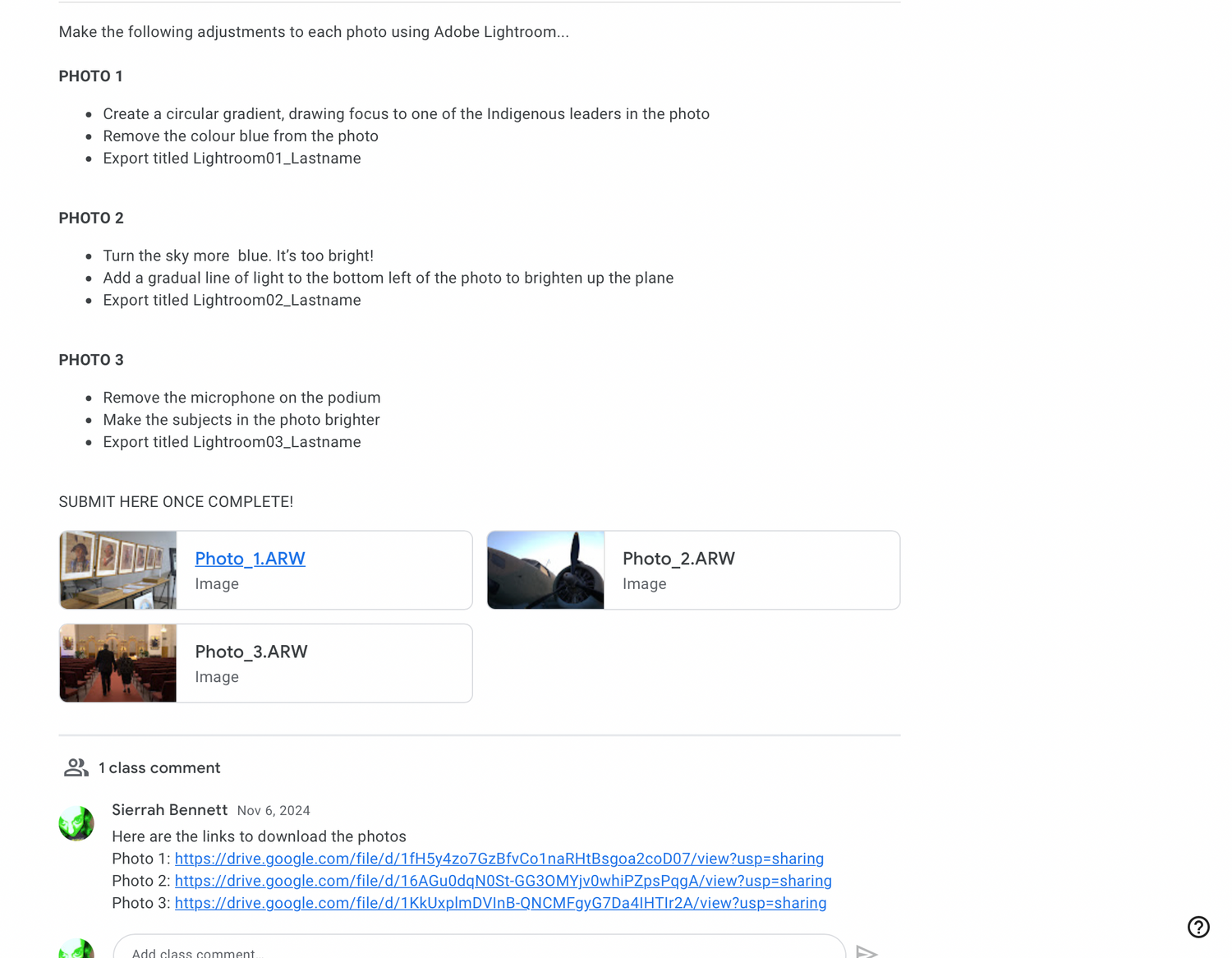
As a non-indigenous person, this is the aspect of the Teaching Quality Standard I struggle with the most, especially in regards to teaching photography. However, this is an example of how I structured one of my technical lessons to have a focus on Indigenous photos, history, and learning. In this Intro to Lightroom lesson, I had included a photo of various Indigenous leaders taken at a pop-up Indigenous history exhibit in our local mall. During this lesson, I took the opportunity to tell students about each one of the Indigenous leaders in the photo and their history to our area located on Treaty Six territory. I also encouraged my students to check out this pop-up exhibit to learn more about our area before colonization. Some students had gone to this exhibit after the lesson and provided me with feedback that they learned a lot of about the Indigenous ways of life and how they migrated to this part of the prairies, something that they had never learned in their social studies classroom. As a pre-service teacher with a specialization in social studies, it was very interesting to see my two worlds of photography and humanities collide.
ARTEFACT SIX: FOLLOWING FOIP PROTOCOLS
TQS-6: Adhering to Legal Frameworks and Policies
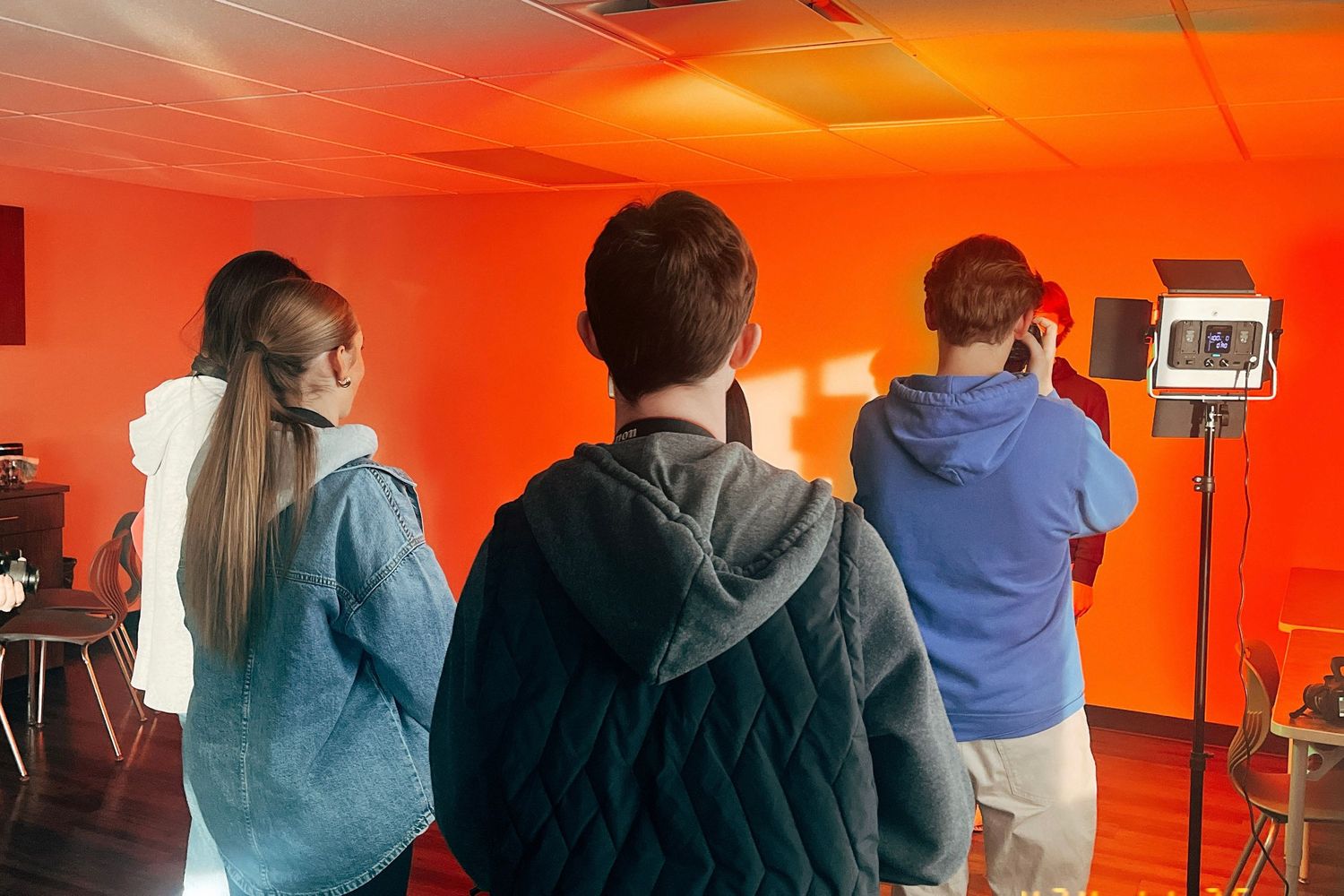
One of the trickiest parts of teaching a photography and communications media class is remembering to follow FOIP protocols. What is FOIP? FOIP is the Freedom of Information and Privacy Act, a policy in place at my local school division to ensure that students' faces are not posted online or involved in any school marketing materials. Within the classes I was placed in, my partner teacher and I like to showcase behind the scenes materials of students working on their projects and their projects themselves. To ensure that I was respecting the students' privacy, regardless of whether or not their parents signed off on the FOIP form, I only showcased non-identifiable angles of them such as the backs of their heads.
Following FOIP protocols required constant mindfulness. Another example of this was when I had to consult the division office about their policies regarding my field instructor conducting my observations over Zoom. Since my field instructor was not part of the Lloydminster Catholic School Division, she was not permitted to see or record any students in the class while virtually observing my lessons. I am very glad I checked with the division office beforehand. Although it was not done with bad intent, it would still have been against my placement school’s policies.
Connect
How my artefacts, experiences, and understandings connect to each other and bridge academic knowledge with my life experiences.
Reflecting on my Field Experience III, I found that my artefacts, experiences, and understandings interconnected to bridge academic knowledge with real-life applications in profound ways; more so than I could ever learn in a university lecture. My experiences in the classroom allowed me to embrace the principle of lifelong learning, adapting my teaching practices to meet students' needs while integrating their feedback into my ever-evolving pedagogical approach.
One major gap I noticed was the challenge of effectively incorporating Indigenous perspectives into a technical subject like photography. As a non-Indigenous teacher, I struggle to ensure cultural awareness and accuracy while providing meaningful connections to Indigenous histories, knowledge, and traditions. However, through one of my lessons introducing Lightroom, I found an opportunity to bridge this gap by including a photo of Indigenous leaders from a local history exhibit, specifically one located on Treaty Six Territory just like our community. This allowed me to share Indigenous history and stories around the area, while encouraging my students to visit the Indigenous-owned exhibit. The feedback from students who visited the exhibit after the lesson was both insightful and rewarding, as they shared their newfound knowledge of Indigenous migration and pre-colonized ways of life—topics not commonly explored in depth in their social studies classrooms. This experience emphasized the importance of creating interdisciplinary connections that resonate with students.
Another gap I encountered was navigating the complexities of FOIP protocols at my placement school and within the Lloydminster Catholic School Division. Ensuring student privacy while showcasing their work was a constant consideration. Whether it involved capturing behind-the-scenes moments from non-identifiable angles or consulting the school division regarding virtual observations, I learned to prioritize compliance and mindfulness in my teaching and teaching portfolios. This attention to detail not only reinforced my ethical responsibilities associated with the teaching profession, but also allowed me to model professional integrity for my students.
Student feedback played a critical role in refining my lesson plans and teaching strategies. My students often provided fresh perspectives, particularly regarding lesson structure and the incorporation of diverse learning styles. My partner teacher also gave me so many valuable insights regarding the profession. For example, she encouraged me to include more interactive elements and multimedia resources to engage students with varying preferences. She also showed me how to navigate Google Classroom for seamless assignment submissions. By integrating these suggestions, I was able to design lessons that combined traditional lecture notes, diagrams, exemplar photos, videos, and hands-on activities. This multimodal approach not only enhanced student understanding but also reflected my commitment to fostering an inclusive learning environment.
The hands-on photography activity, where students captured photos under specific conditions, exemplified this integration of various teaching strategies within my lessons. It bridged theory with practice, allowing students to apply their knowledge while providing me with opportunities for one-on-one guidance during work periods. This process mirrored my own journey as a photographer, videography and a lifelong learner—constantly adapting, reflecting, and improving my skills.
Ultimately, I found that my relationship with my students was the most rewarding aspect of this experience. By creating a supportive environment, I was able to build connections that went beyond the classroom. The heartfelt gestures from my students during my farewell potluck demonstrated the impact of these relationships and reinforced my belief in the importance of meaningful connections in education. It inspired me not only to be a teacher to my students, but also a role model.
Through this journey, I realized that teaching is a dynamic process of growth and collaboration with coworkers and students. While gaps and challenges will inevitably arise, they present opportunities for learning and adaptation, ensuring that I continue to grow as an educator committed to lifelong learning and inclusivity.